
PROPOSED SERVICE 09
Road and Pavement Works
External pavements endure repeated wheel loads, turning shear from heavy vehicles and direct weather exposure. Tectonic Raft constructs rigid concrete pavements, industrial hardstands and granular subbase accessways engineered from the subgrade up.
WHY THIS SCOPE MATTERS
Site challenge & practical use case
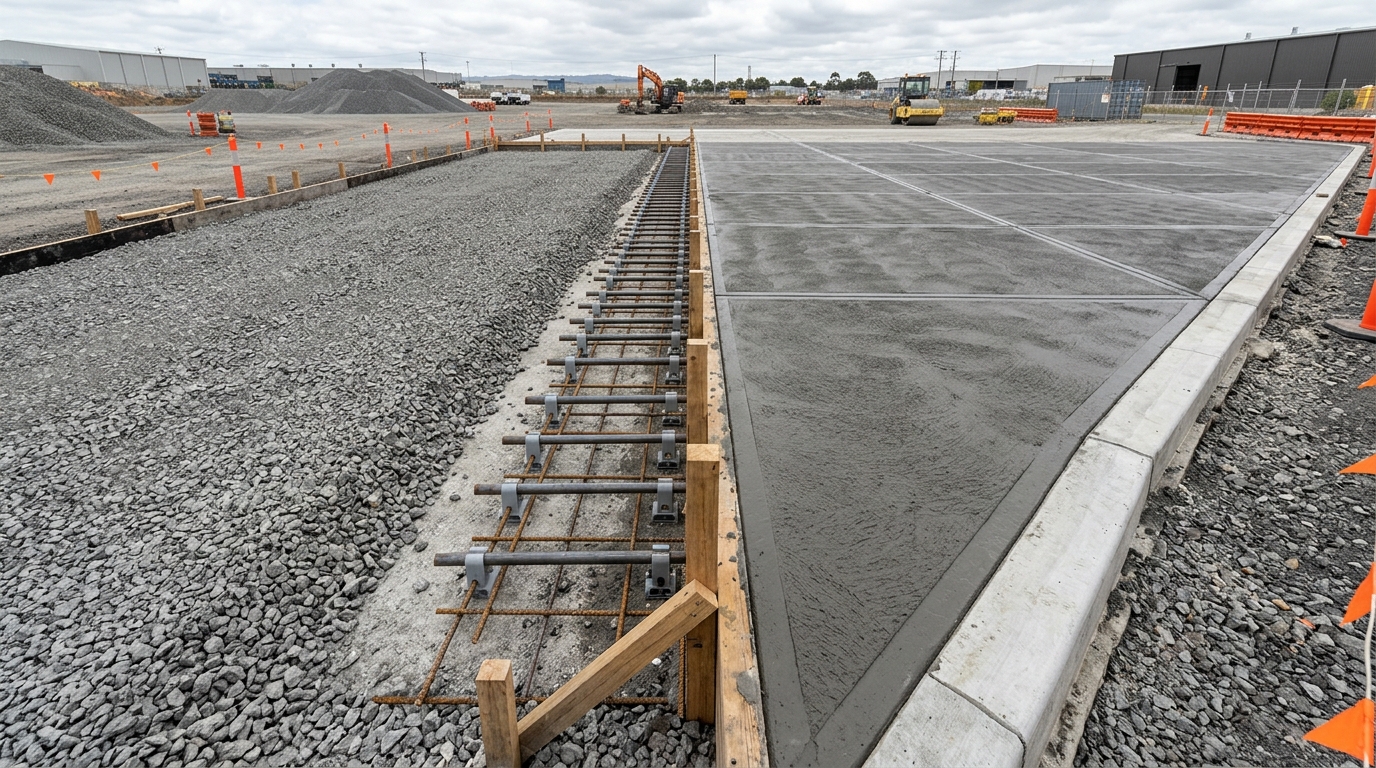
Pavements laid over poorly compacted subbase or built without load-transfer dowels pump water, spall at joints and crack under truck traffic. Matching subbase thickness, concrete strength and joint layout to actual vehicle axle loads prevents premature failure.
SCOPE DEFINITION
What is included—and clear service boundaries
Defining scope boundaries upfront prevents assumptions between civil, engineering and building trades.
- Subgrade boxing-out, proof rolling, lime/cement stabilisation interface or geotextile separation where specified
- Crushed rock roadbase placement, grading to crossfalls and vibratory compaction
- Rigid reinforced concrete pavements with dowelled expansion and contraction joints
- Broom, cove or slip-resistant external finishes suited to vehicle and pedestrian grades
- Cast-in-situ kerbs, spoon drains, channel grates and Heavy-duty vehicle crossovers
- Saw-cutting and joint sealing to control shrinkage cracking and surface water entry
- Works on public roads or council nature strips require council crossover/road-opening permits and approved traffic management plans
- Hot-mix asphalt wearing courses (where specified over civil roadbase) are laid in coordination with specialist asphalt paving crews
Final inclusions, exclusions, engineering hold points and licensing confirmations are documented in writing within each project quotation.
DELIVERY WORKFLOW
How road and pavement works progresses
Each stage completes verification checks before moving to the next phase.
- 01
Traffic Load & Fall Review
Check pavement design thicknesses, drainage crossfalls and threshold heights at building entries.
- 02
Box-Out & Subbase Compaction
Excavate to design depth, proof-roll subgrade and compact crushed rock subbase layers.
- 03
Reinforcement & Joint Set-Out
Set formwork, dowel cradles, isolation joints around pits/columns and reinforcement mesh.
- 04
Pour, Texture & Saw-Cut
Place and finish pavement panels, apply slip-resistant texture, cure and saw-cut control joints on time.
FREQUENTLY ASKED QUESTIONS
Questions about road and pavement works
Have a project-specific question not covered here? Visit our general FAQs page or send us your drawings directly.
Smooth steel dowels allow adjacent slab panels to expand and contract horizontally while transferring heavy wheel loads across the joint so panel edges do not step or crack.
Early-entry or conventional saw-cuts must be made within the initial curing window—as soon as the concrete supports the saw without raveling—before random shrinkage tension cracks develop.
Crossfalls are set by the civil engineer—steep enough to shed rainwater cleanly toward grated drains or pits without ponding, yet gentle enough for safe forklift and truck operation.
RELATED PACKAGES
Complementary site & concrete services
Civil Construction Works
Integrated site infrastructure, bulk groundworks, service corridors and civil packages coordinated to engineering drawings.
Drainage and Stormwater Works
Subsoil agricultural drains, stormwater pits, detention systems and surface overland flow management around structures.
Commercial Building Works
Ground-up commercial substructures, industrial hardstands, concrete packages and civil-to-structure base-build delivery.
Building a heavy-duty hardstand, driveway or access road?
Send through your site suburb, engineering plans or project summary and we will review the scope with you.